

Circularity Policies in 2025: What's Next?
10th February 2025
Author: Diana Calmic
'More than a third of Global Fortune 100 firms will commit to circular economy goals in 2025' (Forrester, 2024)
Circularity is crucial in achieving a truly sustainable economy. Yet, this can be easily forgotten in our race to decarbonise.
In 2024, the UK introduced the Zero Emissions Vehicles (ZEV) Mandate, which sets the ambitious goal for 80% of all new cars to be zero emissions by 2030. This mandate prompts UK manufacturers to roll-out clean technology as fast as possible.
At the same time, the UK and the EU are making large strides to ensure that the production of ZEVs and EV batteries is sustainable and follows the principles of circularity. Specifically, the principles of reuse, repair, and recycle to minimise waste and extend the product lifecycle.
In the UK, key efforts include the UK’s Battery Strategy (2023) and the Circular Economy Package (2020); and in the EU, the New Batteries Regulation (2024) is key, as part of the wider Eco-design for Sustainable Products Regulation (2024) affecting 7 supply chains.
These comprehensive policies and regulations will become even stronger in 2025 and beyond, with more developments on the horizon.
In this article, I investigate the suite of circularity regulations that are either active or upcoming for the UK market, with an overview of similar developments in the EU and the US.
My analysis answers two questions:
1.
What are the key circularity policies and regulations facing UK businesses in 2025?
2.
Who are the key policy makers to watch for guidance and updates in 2025?
To answer the two questions, I start from first principles by defining the term 'circularity' and the circular economy model.
Next, I identify how businesses can apply the principles of circularity at each stage of their value chain, and the challenges that they face at each stage.
Then, I investigate how policy makers and regulators are helping the market overcome these challenges and enable circularity.
The details of my approach can be found in the exhibit below (Exhibit 1)
Approach
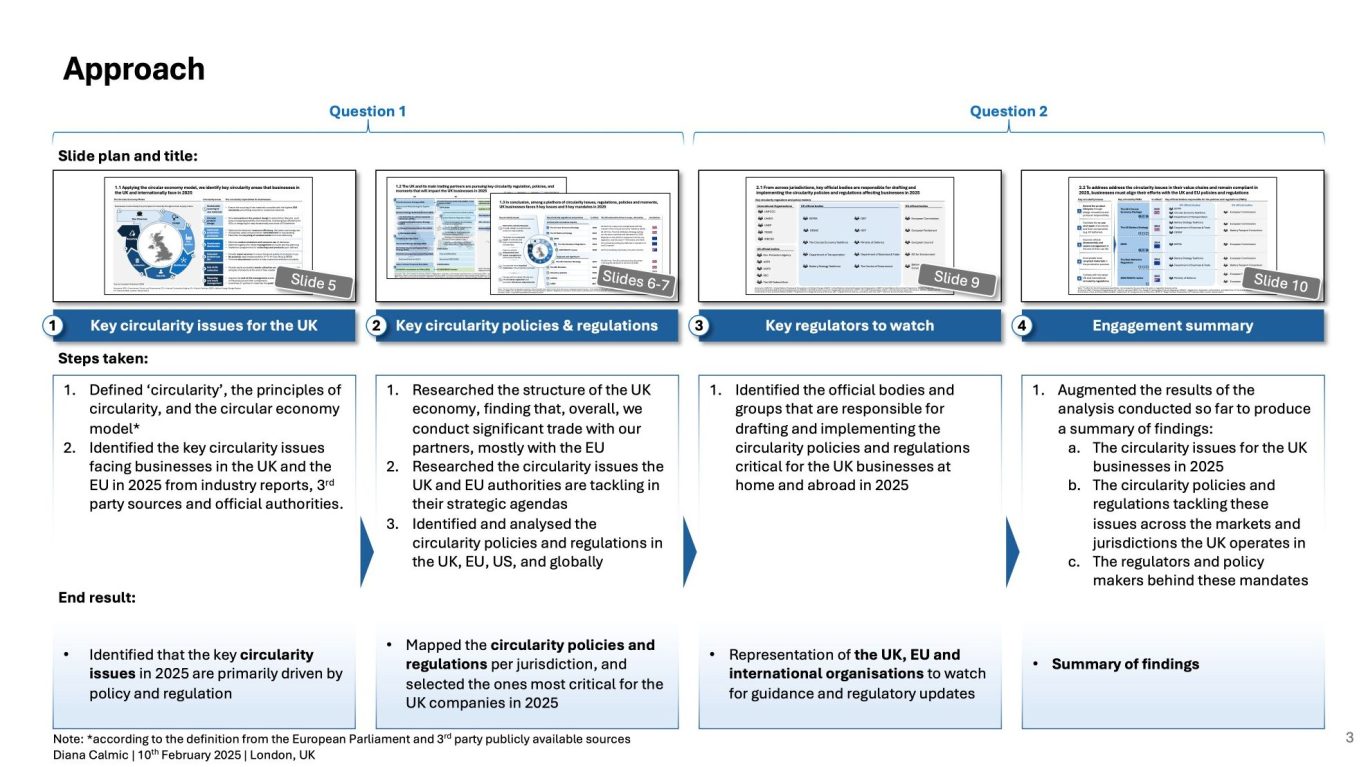
(Exhibit 1 – Approach)
Question 1
1. What are the key circularity policies and regulations facing UK businesses in 2025?
To become a sustainability leader, the UK needs to excel in more than one area of sustainability, which includes adopting a circular economy model.
For the private sector, this means applying the circularity principles of reuse, repair and recycle across their production chain, whilst for the public sector, this means designing and adopting timely policies and regulations that encourage circularity practices and address the ensuing challenges of implementation.
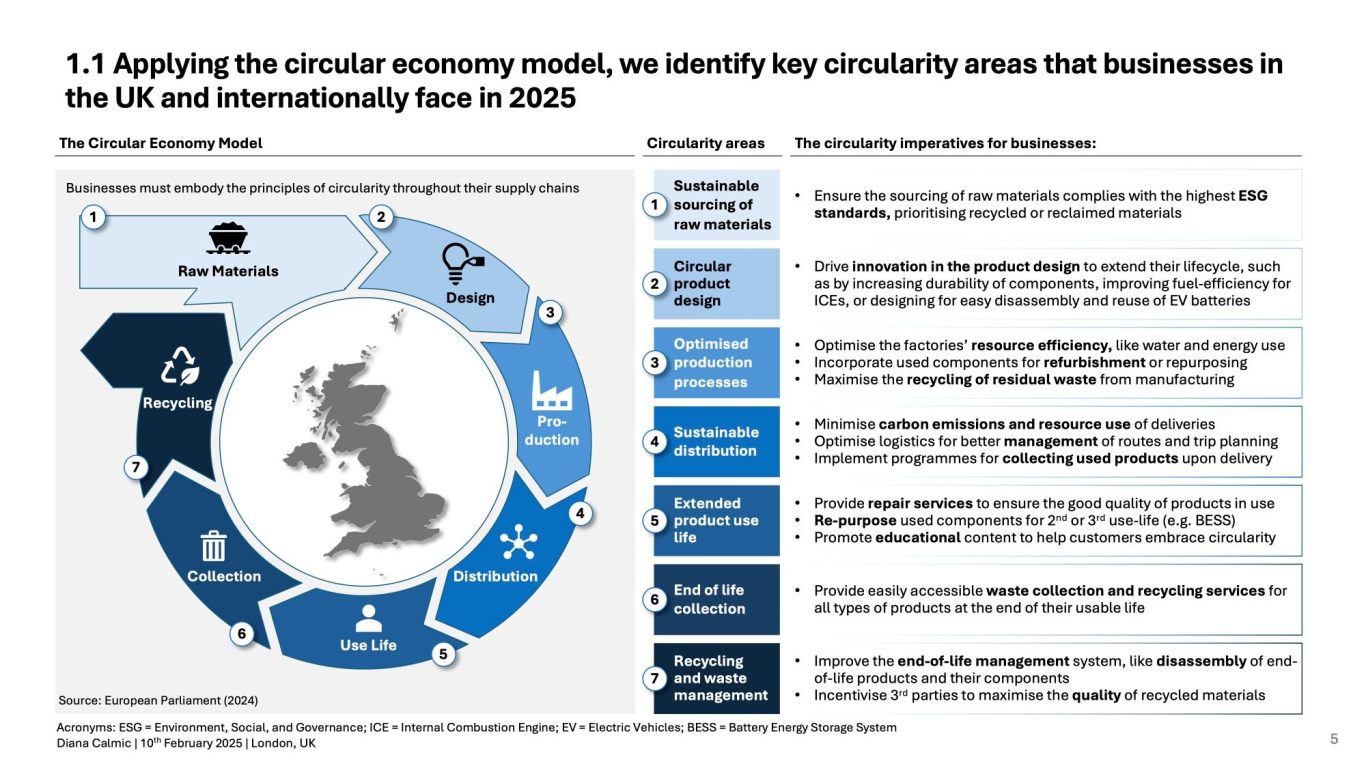
The principles of circularity need to be applied throughout the product lifecycle. A typical product lifecycle, or product value chain, can be categorised into 7 stages, starting from the sourcing of raw or recycled materials, to the design, production, distribution, collection, and finally end-of-life management of waste.
In an ideal circular economy, businesses must implement the principles of circularity at every stage of the value chain. Namely:
- The majority of raw materials must be sourced from recycled components,
- Products must be designed for maximum durability and reusability,
- Production facilities must optimise energy and water usage and maximise re-use of production materials
- Distribution systems must optimise delivery to minimise energy usage and emissions
- Repair and repurposing services must be easily available for the customer when products become defective
- Collection services must be readily available and accessible at the end of the product's use life
- Waste management systems must efficiently process used products for either recycling, repurposing, and re-introduction into the value chain.
Exhibit 2 below provides an in-depth analysis of the circularity imperatives businesses face at each stage.
In order to encourage circular practices in the private sector, as well as set performance standards, public sector institutions in the UK, EU, US and internationally are accelerating their efforts to develop and deploy circularity policies and regulations.
Exhibit 3 below provides a comprehensive map of the circularity regulations, their implementation date, and the enforcing jurisdictions in the UK, EU, US, and across borders.
Notable developments in the UK include the entry into force and constant update of the Circular Economy Package (2020) policy, the definition of the UK Battery Strategy (2023) that follows the EU Battery Regulation closely, and the ongoing UK REACH consultation for the management of chemicals also closely aligned with the EU REACH revision.
In the EU, the ongoing strengthening of the comprehensive ESPR regulation is a major development, followed by the mandatory EU Batteries Regulation (2024) and the revision of CSRD and CSDDD. The US is experiencing tectonic shifts in its approach to sustainability policy in general following the recent elections, with the possibility that circularity policies might be deprioritised going forward. On the international scene, the COP30 is a major development because 2025 is the year in which the UK and all signatories must present their progress on the Nationaly Determined Contributions, as well as the National Circular Economy Roadmaps (2024, UNIDO).
(Exhibit 2 – The Circular Economy Model)
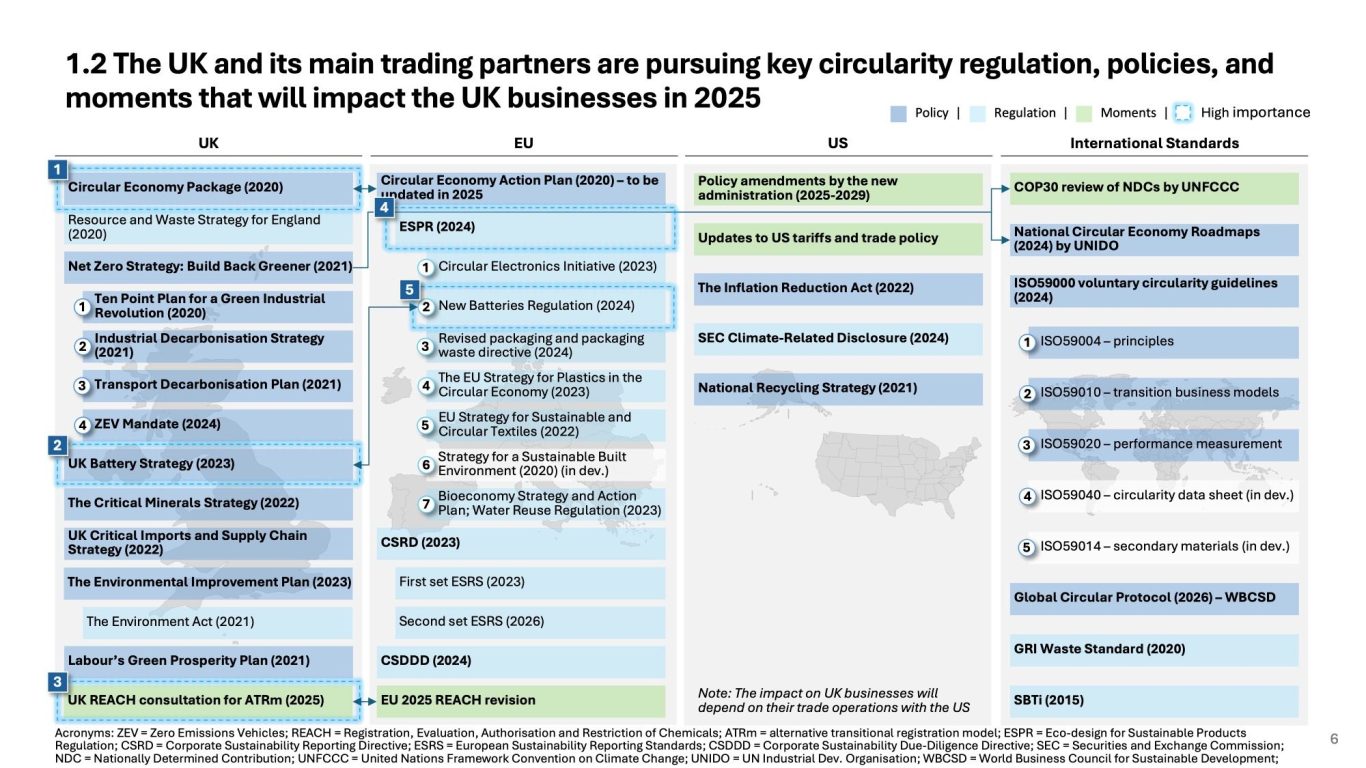
(Exhibit 3 – Circularity regulations and policies in the UK, EU, US, and internationally)
Having mapped both the key circularity imperatives and the key policies and regulations that encourage a circular economy, we can now deduce that businesses in the UK face 5 key policy priorities and 5 adjacent policies that are developing quickly.
The 5 critical policy priorities for the UK businesses:
- The UK Circular Economy Package
- The UK Battery Strategy
- The EU ESPR
- The New Batteries Regulation
- The UK and EU 2025 REACH review
The 5 policies that UK businesses must follow closely:
- The UK's Net Zero Strategy
- The ZEV Mandate
- the US policy updates
- CSDDD updates
- CSRD updates
Exhibit 4 below provides further details on this list of priorities:
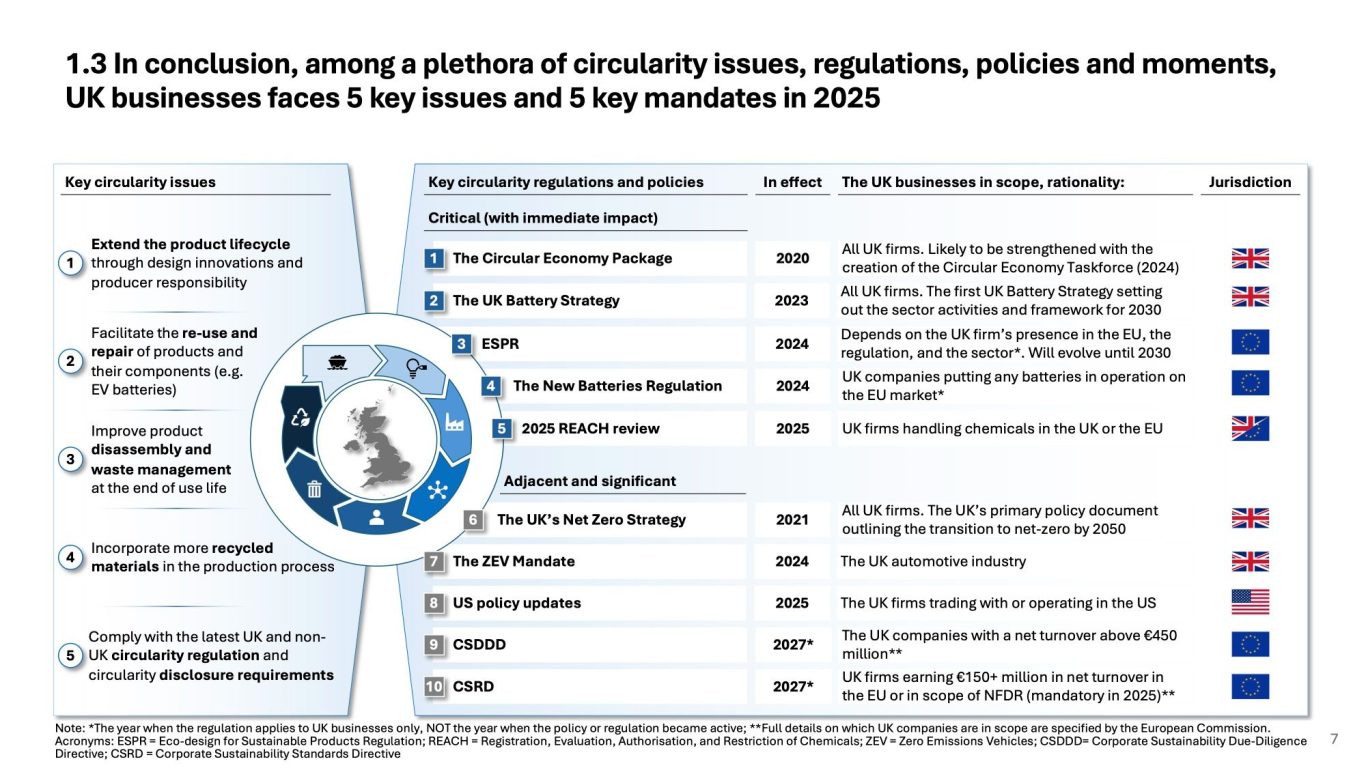
(Exhibit 4 – Overview of circularity issues and circular policy priorities)
The circularity policies and regulations impacting businesses are constantly changing. As such, it is useful to map the list of public sector organisations that are actively updating these regulations. I explore this in the next section below.
Question 2
2. Who are the key policy makers to watch for guidance and updates in 2025?
To stay compliant, businesses in the UK and internationally must make sure they follow the latest updates and guidance as communicated by key regulators and government institutions.
In the context of circularity, the following institutions provided in Exhibit 5 are shaping the regulatory and policy landscape in their respective jurisdictions, whether it is the UK, EU, US, or across borders.
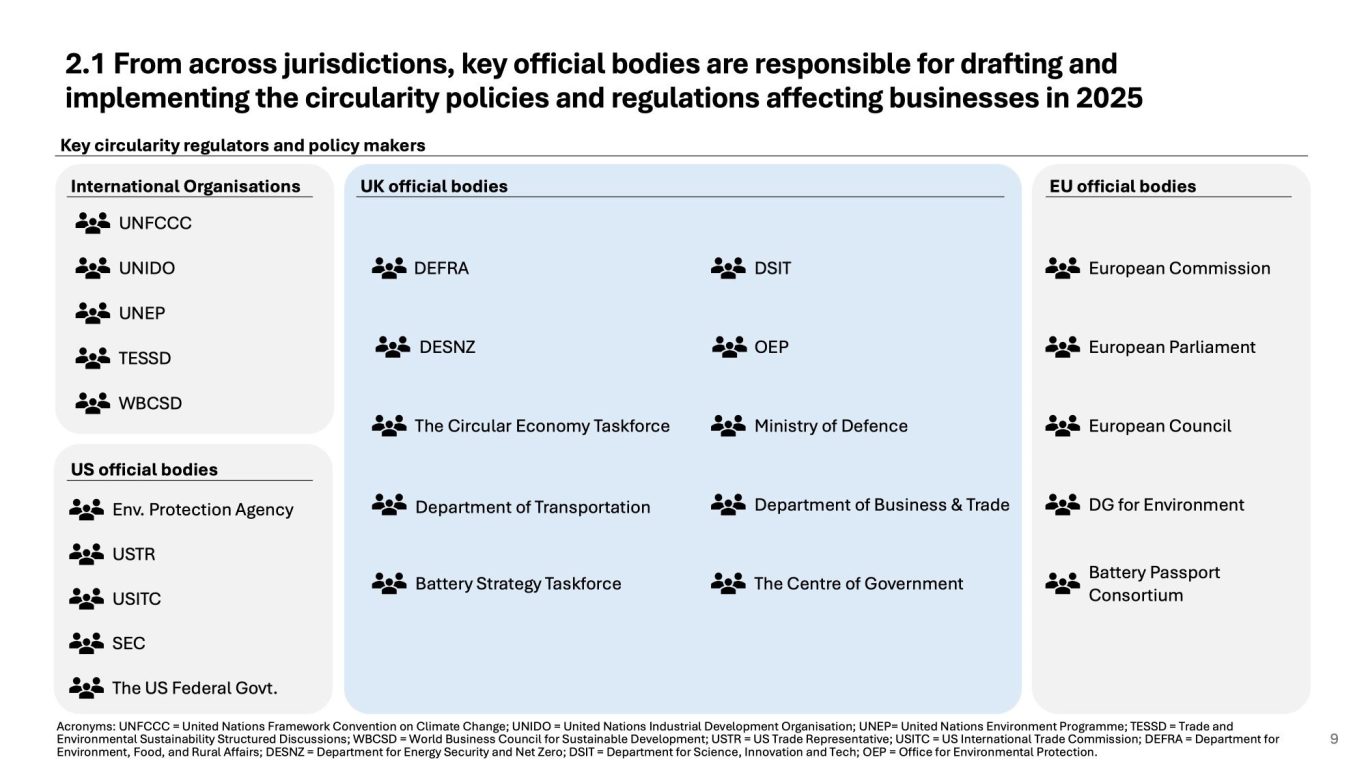
(Exhibit 5 – Key circularity policy makers)
In order to develop a corporate strategy that is compliant with the latest regulations in circularity, corporate leaders must connect the dots between:
- What are the circularity practices their business is implementing (either currently or in the future)?
- What are the regulations impacting their business (now and in the future)?
- Who is enforcing these regulations and can provide guidance for compliance?
Combining these 3 questions together, we can create an eagle's eye view in Exhibit 6. In this overview, I connect each circularity issue with its corresponding regulation or policy, and it turn, its enforcing authority, jurisdiction, and date of implementation.
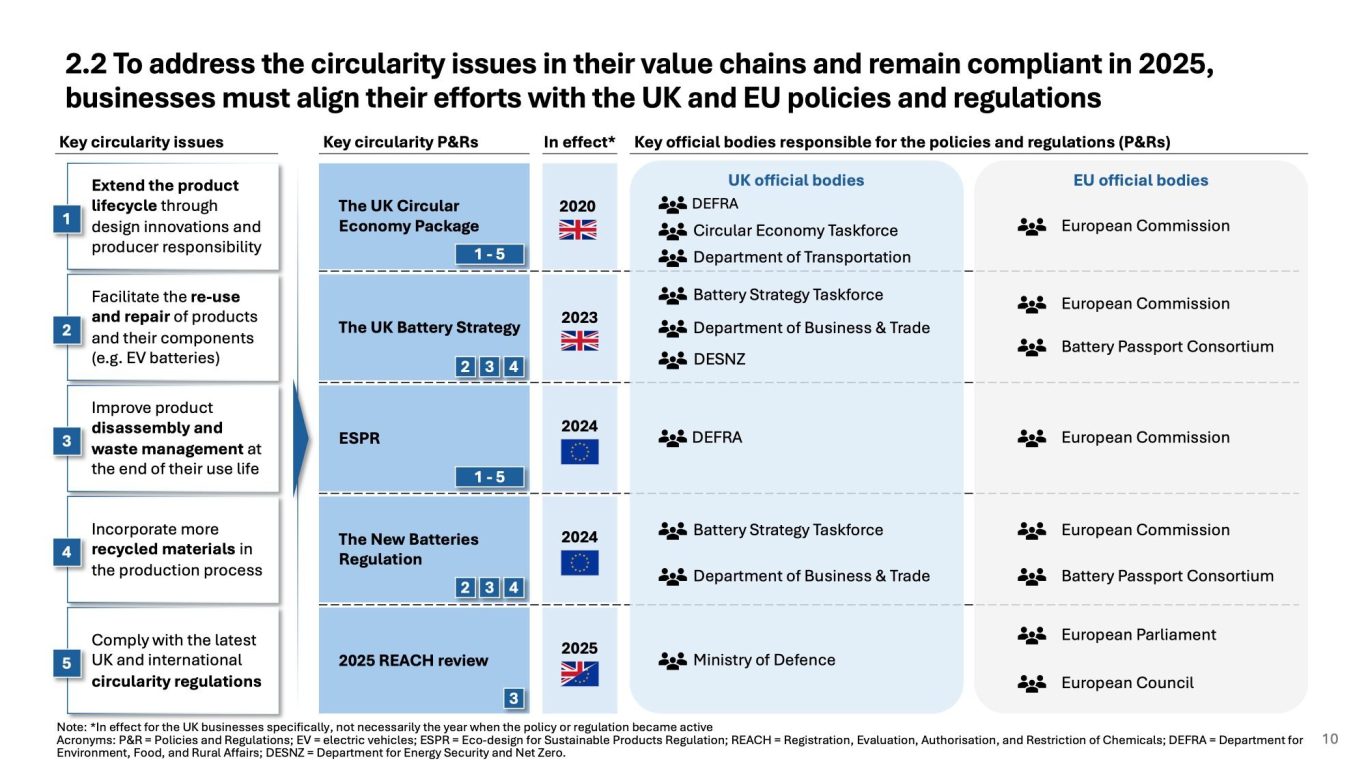
(Exhibit 6 – Conclusion)
All in all, the circularity policy landscape is constantly changing, and the rate of change has accelerated in the past few years. This rate of rapid change will only continue, with businesses facing a highly uncertain and shifting regulatory, political, and economic landscape.
To stay abreast, businesses should make sure that they are clear on the circularity actions they are taking, the regulation or policy that impacts them, and the authority that they can consult for updates and guidance.
I would love to hear your perspective.
Feel free to visit my LinkedIn page for thoughts and weekly updates, and I look forward connecting on sustainability.