When Change Becomes Transformation
Two frameworks to identify triggers and decode the archetypes of transformation
19th March 2026
by Diana Calmic
We live in an era of high uncertainty, rapid change, and increasing complexity.
As such, organisations are facing a constant battle to stay competitive, valuable, and relevant.
At the same time, the ability to adapt to new forces is a competitive advantage. Companies like Netflix and IBM have maintained their top positioning on the market by reinventing themselves while uncompromising on their identity.
For instance, Netflix has undergone two major strategic shifts: from a DVD‑by‑mail rental service to a global streaming platform, and then to a streaming platform that also produces large‑scale original content. Throughout these shifts, it maintained a core focus on using data to personalise entertainment and on delivering a convenient, on‑demand viewing experience.
However, incorporating agility by adapting and innovating without suffering from transformation fatigue and loss of identity, is easier said than done.
So, what are the transformation drivers that leaders should look out for?
The Transformation Drivers Framework
Using the Ishikawa method, the MECE structuring approach, my experience as a strategy consultant and those of my senior colleagues who helped me cross-check it, as well as light use of AI to check for completeness of reasoning, I mapped 40 specific triggers across 8 domains (Exhibit 1):
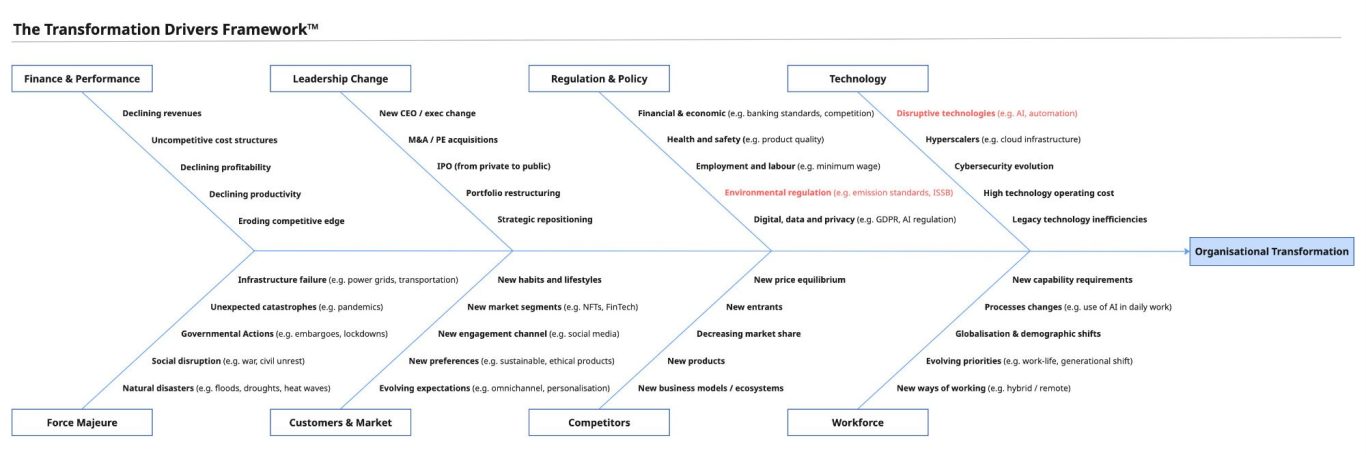
I would not claim this covers every single possible trigger, but it represents a significant portion of the key triggers. You will likely recognise some of the more familiar ones (highlighted in red), such as the impact of AI on the organisational ways of working, the challenges of sustainability reporting under frameworks like the ISSB, or the supply chains risks arising from conflicts, wars and embargoes, are just part of the story.
Organisations use a more complex constellation of signals to decipher when and what to change.
However, organisational transformations are rarely caused by just one trigger. A combination of 3–4 triggers simultaneously (such as technology disruption, customer expectations shift, new CEO strategy, and financial pressure) is necessary to create a transformation tipping point.
Based on the insights from McKinsey & Company, Bain and Co, BCG, and the frameworks of Michael Porter, Clayton Christensen, strategic management frameworks, and PROSCI insights, we can begin to classify organisational transformations into a Four Transformation Archetypes.
The Four Transformation Archetypes
This model can help leaders answer the question: “Why is the organisation transforming?”
Thus, triggers are categorised into the 4 most common archetypes of transformation tipping points (Exhibit 2):
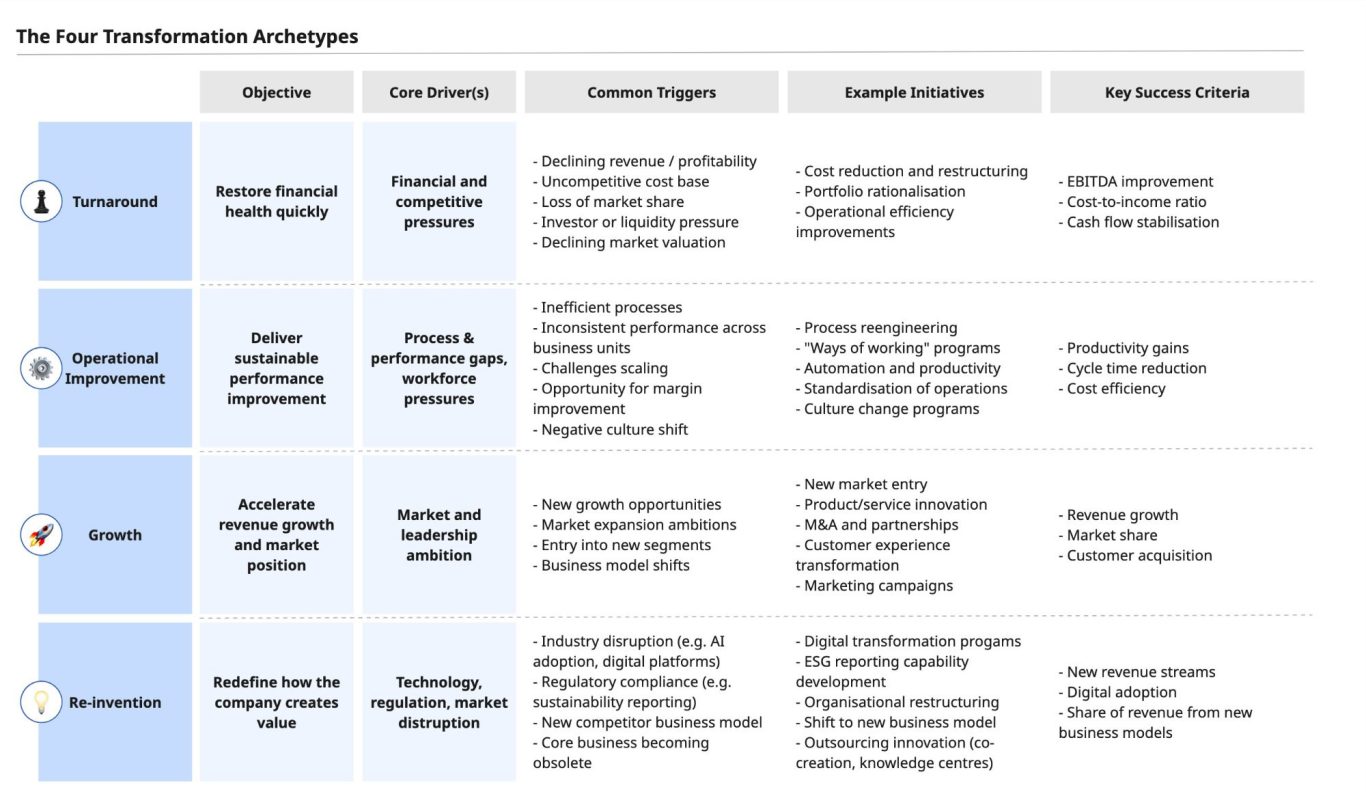
Note that this is a simplified model of transformation. Real transformations are multi-dimensional have multiple nuances. (More about this model in Disclosures, at the end of the article)
01
Turnaround
Organisational transformation to Fix the Business is often triggered by the financial and competitive pressures, such as low margins and decreasing productivity.
The transformation is required to find a financial remedy fast and restore financial performance. Typical success criteria include KPIs that track financial health.
02
Operational Improvement
Organisational transformation to Improve the Business is often triggered by gaps in performance, processes or workforce pressures, whereby the organisations is not operating at its full potential.
Commonly, a transformation is required to improve the ways of working and close performance gaps to sustain competitiveness and meet business objectives.
I have seen this challenge come up in some of my transformation work. For instance, a Telecom client was transforming their ways of working to improve time to market across borders while also aiming to reduce costs by around a third.
03
Growth
Organisational transformation to Grow the Business is often triggered by the leadership ambition and market opportunities to expand either the product range, customer segments, geographical reach, improve product pricing, or all at once.
This transformation is commonly characterised by new market entry campaigns, innovation and new product development, or new pricing strategies.
I have seen this challenge in some of my work as well, such as during the long process of defining, founding and scaling a new corporate offering to meet the evolving client needs.
04
Reinvention
Organisational transformation to Reinvent the Business is often triggered by existential disruptions, such as technological advancements (e.g. AI), regulatory changes (e.g. sustainability mandates as a license to operate), or competitor or market disruption.
Commonly, initiatives to address these shifts focus around moving the organisation to adapt to the new normal, such as investing in digital transformation, ESG reporting capabilities, and breaking silos in organisations for co-creation, alignment, and innovation.
I have seen this challenge come up for a client as well, a global car manufacturer who was pursuing a core banking transformation to redesign the way they help their customers finance their car purchases.
Conclusion
The Transformation Drivers Framework™ and the Four Transformation Archetypes™ can help leaders understand:
a) What is the root cause and what triggers are they witnessing in their organisation?
b) How close are they to a transformation tipping point?
c) And if they are already transforming, what archetype is the closest match and what initiatives might help meet their objectives?
This is a quick and general analysis of the organisational transformation triggers and archetypes agnostic of industry or geography. A targeted analysis with a clear end-goal for a specific program or organisation can reveal much more insights into “why” and “what” needs changing (if anything).
Furthermore, as the coauthor of the book ‘The Secret of Culture Change’ Jay Barney, the author of the book ‘Good to Great’, Jim Collins, the PROSCI body of knowledge on organisational transformation, and many other authors have noted, organisational transformation is underpinned by a cultural transformation.
Without the people enacting the change, no amount of planning will, by itself, move the needle.
In my next article, I will explore the different types of organisational transformation (from digital to cultural), and the people, processes, technologies, and governance change impacts.
Most importantly: If you have additions, amendments, challenges, or comments, by all means get in touch. I would love to hear your perspectives, success stories, and lessons learned from organisational transformation (or even more broadly on strategy, leadership, decision making, or client stories)!
If you found this article insightful, follow for more. I write on adaptive organisations, strategy, leadership, and decision-making in high-pressure environments.
Disclosure:
Exhibit 1, The Transformation Drivers Framework, strives to capture a significant portion of potential triggers by using brainstorming, MECE structuring techniques, and professional experience from myself and peers. Even so, it is possible that there may be many more transformation triggers that are not yet captured in this diagram. If you think I’m missing some, let me know!
Exhibit 2, the Four Archetypes Model, is a synthesis of recurring transformation patterns observed across strategy literature and consulting practice, grounded in sources: McKinsey and Company, Bain and Co, BCG, Michael Porter, Clayton Christensen, strategic management frameworks, Lean / Six Sigma body of knowledge, and the PROSCI change transformation methodology.
This model simplifies a very complex domain of organisational transformation that inherently has multiple nuances and dimensions, with the goal of helping leadership frame the problem quickly and align stakeholders with greater ease.
It has 5 inherent assumptions: 1) all transformations are goal-driven, 2) a dominant driver exists, 3) transformations cluster into repeatable patterns, and 4) business model disruption is categorically different, 5) internal and external triggers can be abstracted.
The strengths of this model are that it syntheses real transformation archetypes observed in practice, aligns with multiple well-established frameworks, and provides a clear and easy method for leaders to diagnose and communicate change.
Weaknesses of this model include the potential for some transformation cases to straddle the boundary between growth and re-invention, as well as the fact that this model provides only a generalised view that does not account for industry specifics.
It was created with the help of an AI agent who was instructed to act as a PROSCI certified change management professional with 20+ years of experience in the field. All of the points and assumptions made in this model were checked and tested to the best of my knowledge with my colleagues. If, however, you believe it can be improved further, I would be happy to hear your ideas!